Early Notes on: Meditation
There are so many different types!
Originally published on my blog on May 18, 2025.
Italicized terms are in Sanskrit unless otherwise specified.
I think more beginners should write a quick 500 words about their experience with a new activity. Then it’s not just the experienced folks talking about the thing in a way that’s detached from the beginner experience, as they’ve forgotten what it’s like to be a beginner.
So here are some of my notes on meditation as a beginner, having looked into it for a few months now.
There are different types of meditation
This is important because the type of meditation you do will determine the experience you have, and some people have a much better time with certain approaches vs others.
From what I’ve learned so far, there’s a rough 2x2 model for different types of meditation techniques – {open awareness, focusing} x {grounding, inquisitive}.
Here are my own loose definitions:
Open awareness = letting thoughts arise → then noticing what comes up
Focusing = concentrating on an object or task → to quiet the mind
Grounding = concentrating on or experiencing sensations → to quiet the mind
Inquisitive = examining a phenomenon → then noticing what comes up
Here’s how I’d categorize some practices I know of:
Noticing the mechanics of the breath – open awareness, inquisitive
Staring at a wall for 30 mins and seeing what comes up – open awareness
Nadi shuddhi (alternate nostril breathing) – focusing
Metta (Pali1 for loving-kindness) – focusing, inquisitive
Cold plunge – grounding
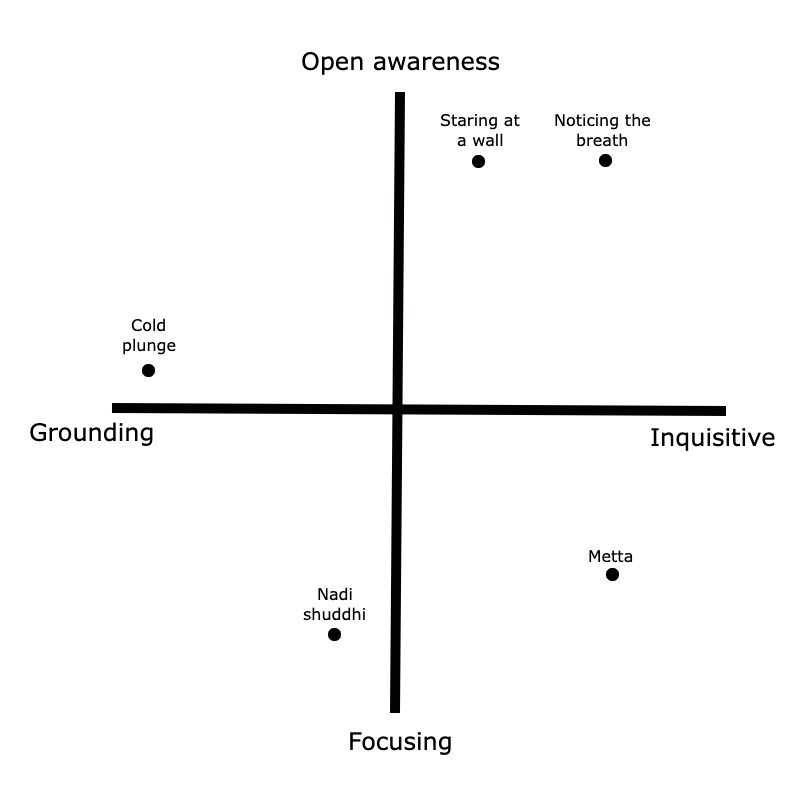
Different approaches have different effects. Open awareness practice, for example, might not be a good starting point if you like to repress stuff, as those repressed thoughts might come rushing to the surface. A focusing practice might be more beneficial for you in this case. Or if you have ADHD, I highly recommend trying a focusing practice like nadi shuddhi – see the “How did I start?” section below for instructions.
Why did I start?
1. Strengthening – it’s like going to the gym for your mind
Many types of meditation help strengthen your prefrontal cortex, which is responsible for decision-making and executive function. This sounded appealing to me.
Imagine you’re a CEO of a company, and you have a bunch of VPs reporting to you. Except the VPs have a lot of demands from the parts of the business they oversee, and they make demands of you. Sometimes loudly, sometimes covertly. And as the CEO you find yourself often caving to their demands to appease them. This is sometimes how I am with my emotions. Sometimes I do things that I don’t want to do, but that feel like I must do, in order to satisfy some emotional need so that I don’t go crazy.
Meditation can apparently help the CEO-you be less at the mercy of your emotions/desires/whims. There’s ways to notice them, take them into account, breathe through them, and have them pass through you in a less painful way.
Also like with going to the gym, meditation is not necessary for living. But there are definitely some benefits. And similarly with the gym, you can choose how intense you want to be, as well as what goals you actually want to work toward (e.g. strength vs. aesthetics vs. mobility and stability, etc.).
2. Calming – it feels nice
At the end of most meditation sits I’ve done, I range from feeling a little bit more relaxed to very relaxed. I know people who’ve been meditating for a while that get super blissed out after a 30-min meditation, and that seems kinda cool too.
One caveat here is that I think the type of meditation you do matters. E.g. with open awareness practice and surfacing repressed stuff that you don’t want to face, you probably aren’t going to come out of it feeling very relaxed.
I’ve also heard that if you meditate consistently enough, you will inevitably run into painful inner stuff, regardless of the type of meditation you do or how aggressively you tend to repress things, just by nature of us all having our own hang-ups. So it may not be an exclusively feel-good thing.
3. Cultivating – Metta, and Self-Love
I’ve written previously about wanting to develop more self-love, spurred on by discoveries during my sabbatical. And one way I heard you can do this is through metta meditation, also called loving-kindness meditation.
Here’s a great primer video on metta, including an exercise to try out for yourself.
If I were to describe it, I’d say metta is practice in:
Noticing what loving different people feels like
Noticing what loving myself feels like
Increasing my capacity to generate feelings of love toward myself and others
So far it’s been pretty nice, and I’ve definitely noticed my capacity improve.
4. Contentment as a Need of the soul
Very briefly: in Hinduism there’s this concept of purushartha (which happens to be very analogous to Maslow’s Hierarchy of Needs). It describes 4 possible dimensions that people can pursue to have a happy life:
Artha ~= material needs, financial means
Kama ~= social and relational needs, pleasure, love
Dharma ~= life purpose needs, doing the things that only you can do
Moksha ~= “soul needs”, contentment, liberation
In Western society, we tend to focus on 1 and 2, while we bumble around trying to figure out 3. But even when you have all of 1-3, you may find that something still feels missing, and that’s where moksha comes in.2
Meditation is apparently one way to feed this dimension of “soul needs”.
How did I start?
I started with metta and nadi shuddhi (alternate nostril breathing), for 10-20 mins total.
This metta video got me started, and it has everything you need. And here’s a free video on nadi shuddhi.
Currently for my sits, I like to do:
7 mins - nadi shuddhi
7 mins - prana shuddhi
7 mins - metta
This year, I also started attending some group meditations a couple times per month. One is hosted by friends (we mostly do open awareness + metta), and another is Saturday Night Metta hosted over zoom.
How’s it going?
It’s been good. Actually it’s been more than good. It’s strange, I’m not sure why I have this urge to downplay it. But actually I think I’ve experienced a non-trivial amount of positive change from the meditation I’ve done so far, mainly with metta. I’ve noticeably “leveled up” in the amount of love I feel toward myself compared to one year ago. There were even a few days earlier this year where I had the thought “oh wow I actually love myself” and felt this to be true in a way I had never felt before. Much of this progress came from doing well-guided metta meditation (and e.g. identifying objects of vast amounts of love).
And so I want to do more meditation in general.
The purported longer-term benefits of a strengthened prefrontal cortex or moksha still feel largely distant and abstract to me. But I’m motivated to continue and also see if I can experience these firsthand.
Miscellaneous thoughts
Community helps a lot
A good community (”sangha“ in Sanskrit) helps support you, teach you stuff, and prompt you to practice. All of which make getting into meditation and establishing your own routine much lighter. Would recommend.
It’s OK to be goal-oriented
I used to think it was weird and bad to approach meditation in a sort of consumption-oriented way: “I want to meditate to attain this feeling or skill”.
But that’s kind of what it was designed for.
If you’re looking for permission to approach meditation this way, I’ll happily give it. It’s OK to meditate to get skills, feel good, and gain blessings. Hell yeah.
Bonus Resources
I’ve been enjoying my friend Dr. Tucker Peck’s book Sanity and Sainthood: Integrating Meditation and Psychotherapy on Theravada Buddhism meditation and philosophy, and therapy
Dr. K’s Guide to Mental Health informed a lot of this post. It not only covers meditation techniques, but it also covers the history of meditation and what it can be used for, which I found incredibly insightful. The guide also covers more general mental health topics too, like how to manage ADHD, anxiety, depression, and trauma
This Dr. K video (3h) on meaning, purpose, and motivation legitimately changed my life. It covers purushartha, dharma, and more
My friend Tasshin leads metta meditations at Saturday Night Metta, and posts his guided meditations on youtube, if want more metta
Most of the italicized terms in this post are in Sanskrit, which is the language Hinduism tends to use and the language I tend to use when looking into these topics. Metta is in Pali, which is the language Buddhism tends to use. The corresponding term in Sanskrit is maitrī. BUT for whatever reason no one I know says maitrī and everyone I know says metta when referring to loving-kindness meditation. So that’s why it’s the only Pali term here and in my vocabulary.
Interestingly, the combination of Religion + Church also fits well with this model of purushartha – Religion fills the needs of: dharma (Sanskrit; life purpose) and moksha (contentment); while Church fills the needs of: kama (relational) and dharma, and maybe even artha (materal) too. Credit to Sam for this observation.